
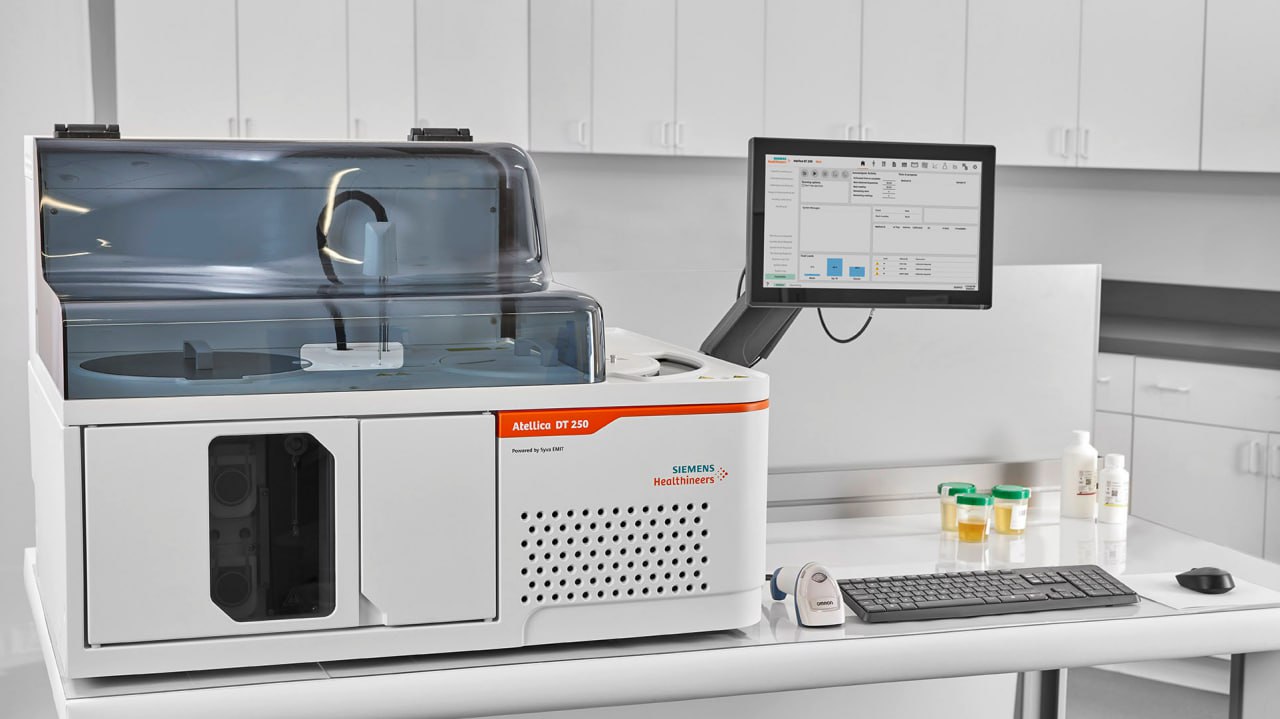
Atellica DT 250 from Siemens Healthineers is a new product on the laboratory diagnostics market. The compact, high-performance benchtop analyzer is designed for drugs of abuse testing and therapeutic drug monitoring.
The system supports a broad test menu for:
- Drugs of abuse: 6-Acetylmorphine; Amphetamines; Barbiturates; Benzodiazepines; Benzodiazepines (high-sensitivity); Buprenorphine; Cannabinoids; Cocaine Metabolite; Ecstasy; EDDP (methadone metabolite); Ethyl Alcohol; Ethyl Glucuronide; Fentanyl; Hydrocodone; Ketamine; LSD; Meperidine; Methadone; Methamphetamine; Methaqualone; Opiates; Oxycodone; Phencyclidine; Propoxyphene; Synthetic Cannabinoids; Tramadol; Xylazine.
- Immunosuppressant drugs: Cyclosporine; Mycophenolic Acid; Sirolimus; Tacrolimus.
- Therapeutic drug monitoring: Amikacin; Caffeine; Carbamazepine; Digoxin; Disopyramide; Ethosuximide; Gabapentin; Gentamicin; Lamotrigine; Levetiracetam; Lidocaine; Methotrexate; N-Acetylprocainamide (NAPA); Phenobarbital; Phenytoin; Primidone; Procainamide; Quinidine; Theophylline; Tobramycin; Topiramate; Valproic Acid; Vancomycin; Voriconazole; Zonisamide.
Technical characteristics
Atellica DT 250 performs up to 225 tests per hour, and the first results are available within 8 minutes. The analyzer is equipped with 48 reagent positions and accommodates up to 95 samples simultaneously.
An intuitive interface, automated workflows, continuous loading of samples and reagents, STAT-mode support, and modern cybersecurity tools ensure high efficiency and safety of laboratory operations.
The use of proven reagents and stable methods guarantees accuracy and reproducibility of results, making Atellica DT 250 a reliable solution for laboratories of various profiles.
EMIT technology — the basis of Atellica DT 250 accuracy
Atellica DT 250 operates with reagents based on EMIT (Enzyme Multiplied Immunoassay Technique), a homogeneous immunoenzymatic method for rapid detection of narcotic substances and therapeutic drug monitoring.
The principle of EMIT: specific antibodies bind to the analyte in the sample → the enzyme-labeled analyte analog competes with it for antibody binding → the level of enzyme activity recorded by the analyzer directly depends on the concentration of the substance in the sample. Due to enzyme signal amplification, the method enables accurate detection of even low concentrations.
The main advantages of the EMIT method include:
- high specificity and sensitivity due to a design that prevents cross-reactivity and ensures reproducible results;
- rapid result generation — first data within a few minutes;
- full compatibility with automated systems and optimization of workflows.
The role of therapeutic drug monitoring in modern medicine
Therapeutic drugs are used to treat various diseases and conditions, and the correct level of their concentration in the blood is critical for effective and safe therapy.
Therapeutic drug monitoring in patient blood allows clinicians to:
• maintain optimal drug concentrations;
• detect non-compliance with dosing regimens;
• assess potential drug interactions;
• adjust dosages individually.
Therapeutic drug testing is typically performed for such classes of medications as: antiepileptic drugs, antiarrhythmics, antimicrobials, antineoplastic agents, bronchodilators, and immunosuppressants.
Atellica DT 250 in the diagnostics of therapeutic drugs and drugs of abuse
Atellica DT 250 provides wide measuring ranges and high accuracy in determining both therapeutic drug concentrations and levels of drugs of abuse. This enables clinicians to adjust treatment in a timely manner, avoid toxic effects, and achieve optimal clinical outcomes for patients.
.png "Customs clearance of medical and laboratory equipment from Daleth Group - Empirica")
.png "Ai5 Lab by Sener — A New Level of Automation in Bacteriology Laboratories - Empirica")
.png "Turnkey Cryobank Development and Equipment - Empirica")